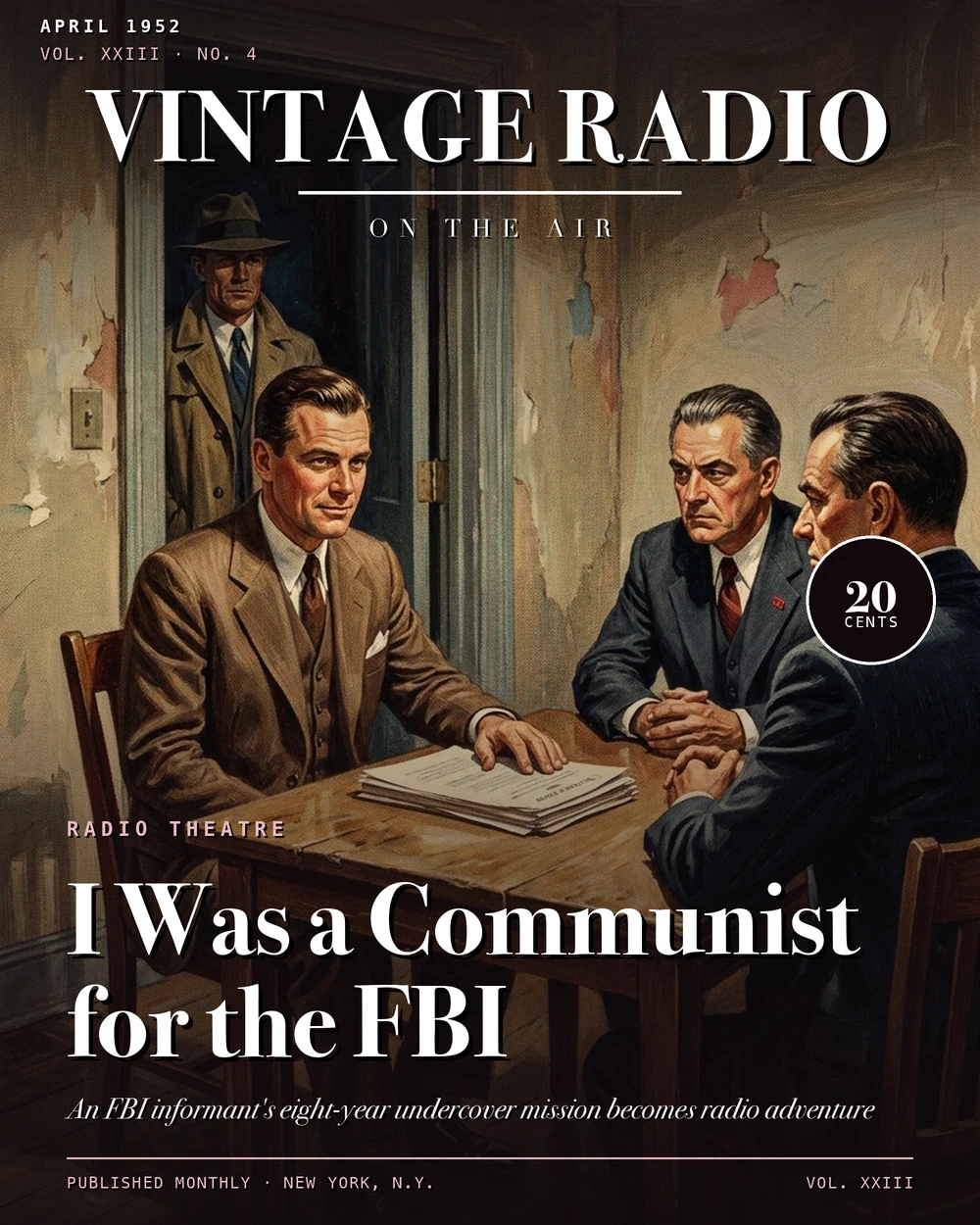
I Was a Communist for the FBI
How a Real Story Became a Radio Franchise
By the time Frederick Ziv's production company put this series on the air in 1952, the story of Matt Cvetic had already traveled a remarkable distance. Cvetic had spent roughly eight years infiltrating the Communist Party of the United States in the Pittsburgh area, beginning in February 1943, before the FBI ended his employment in 1950 due to increasingly erratic behavior. That same year he told his story in three serialized installments in the Saturday Evening Post, written with journalist Pete Martin and published across three Saturdays in July. The ink was barely dry when Warner Bros. purchased the rights and rushed the story into theaters — the film opened May 5, 1951, directed by Gordon Douglas and starring Frank Lovejoy. Variety called it "exciting" and praised Douglas for playing up "suspense and pace strongly." New York Times critic Bosley Crowther found the writing and direction "in a taut style of thriller fiction that the perceptive will recognize" and praised Lovejoy as "a model of tight and efficient resolution."
The film made real money — roughly $1.3 million domestic and $440,000 overseas by Warner Bros.' own records — and earned a nomination for the Academy Award for Best Documentary Feature at the 1952 ceremony, a distinction widely considered anomalous given that the picture was a dramatized narrative feature, not a documentary. Historian Nora Sayre would later describe the film as resembling "Warner Brothers' apology" for its earlier pro-Soviet picture Mission to Moscow (1943). Ziv read all of this correctly. He built a 78-episode radio series on the same foundation, letting the film do the cultural heavy lifting and arriving in syndication while the franchise was still fresh.
The Ziv Machine and How the Show Reached 600 Stations
Frederick Ziv was not a network man. Born in Cincinnati in 1905, he earned a law degree from the University of Michigan in 1928 but never practiced, instead founding an advertising agency and eventually, with writer John L. Sinn, the Frederick W. Ziv Company. By 1948, according to Horace Newcomb's Encyclopedia of Television, it had become "the largest packager and syndicator of radio programs." His model was to record transcribed series, sell them station-by-station at fees scaled to market size, and let local broadcasters fill the time slots — typically outside prime time — with locally sold advertising. The arrangement meant a show could run in hundreds of markets simultaneously without ever touching a network clearance negotiation.
By the end of 1952, I Was a Communist for the FBI was scheduled on more than 600 stations — a reach that surpassed what a conventional network placement would have offered. WOR-Mutual in New York was among the carriers; in smaller markets, local advertisers like the Bakers of Blue Ribbon Cake bought the slots, their names attached to the drama of Communist infiltration somewhere in the middle of the broadcast day. Syndication debut dates varied by market — one documented affiliate first aired the series on April 23, 1952, while the generally accepted franchise premiere is March 30, 1952. The 30-minute episodes were all pre-recorded, consistent with Ziv's standard approach.
Notably, the FBI itself refused to cooperate with the production. No bureau assistance went into making the show, even as FBI files tracked it closely, accumulating communications with filmmakers, production updates, and reviews. In March 1953, an irate listener called the bureau to complain that a radio episode "is not giving the United States any break" and that "the program is obviously infiltrated." The FBI did not take the caller seriously.
Dana Andrews and the Cast
The marquee name attached to the series was Dana Andrews, born Carver Dana Andrews on January 1, 1909, near Collins, Mississippi, one of thirteen children of a Baptist minister. By the early 1950s, Andrews had already turned in the performances he's best remembered for — detective Mark McPherson in Laura (1944) and veteran Fred Derry in The Best Years of Our Lives (1946). His film career had slowed, due in part to his alcoholism, and the radio series occupied a significant portion of his professional life between 1952 and 1954. He brought an air of Hollywood glamor to the Matt Cvetic role, his voice carrying the weight of someone who'd spent time in front of a camera learning how to do less, not more.
Each episode closed with Andrews delivering the same line: "I was a Communist for the FBI. I walk alone." The phrase also served as the title of the first documented surviving episode. It was the kind of signoff that made the series immediately recognizable across a crowded syndication landscape.
The supporting cast was substantial. William Conrad — later familiar to radio audiences from Gunsmoke — appeared in a notable recurring role as Comrade Revchinko, a gruff and sinister Communist party official. Gerald Mohr, Virginia Gregg, Harry Bartel, Lawrence Dobkin, Sheldon Leonard, Parley Baer, Bill Johnstone, and Olan Soule, who played FBI Agent Beaker, all appeared regularly. Music for the series was composed by David Rose. Henry Hayward directed. The episode logs credit Andrews, Soule, and Rose as its three principal contributors.
What the Episodes Were Actually About
The show followed a fairly consistent structural pattern. Cvetic receives an assignment from Communist Party officials and then works to undermine it while staying in contact with the FBI — all without revealing his actual role to anyone, including his own family, who shunned him as a result. The recurring tension was layered: Cvetic could never be entirely sure who around him might be a party spy. He was followed, had his phone tapped by the Communists, and in one episode discovered that he had talked in his sleep in a room the party had secretly wired for recording. Another episode had him diagnosed with hypertension, using a medical detail to dramatize the psychological cost of years of sustained deception. The series' own disclaimer hedged the matter directly, noting that "Many of the incidents portrayed are based on the experiences of Matt Cvetic…" — language that quietly acknowledged how much of each script was invention.
Episode plots ranged more widely than the core formula might suggest. Cvetic tried to take over a Boy Scout troop, escorted a Soviet agent, worked to rehabilitate the public image of a Communist front group, and attempted to sabotage early computer technology. Surviving titles trace the variety — "Little Red Schoolhouse" (May 1952), "Card Game In The Clouds," "Rich Man, Poor Man," "The Red Record," "The Wrong Green," "The Crossed Heart," "Rhapsody In Red." The episode titled "The Black Gospel" broke the usual format entirely: the antagonist was a nihilist who threatened to expose Cvetic as an FBI informant unless Cvetic assisted his anarchist scheme. The Communists in the series were drawn consistently as cold and humorless, oriented entirely toward world domination — a characterization that consciously paralleled how radio drama had portrayed Nazi villains in the preceding decade.
Where the 1951 film concentrated on the end of Cvetic's undercover career, the radio show worked the beginning and middle. That gave it room to operate episodically without always pulling toward the same dramatic conclusion.
The Man Behind the Character
The real Matt Cvetic was a more complicated figure than the radio version. Historian Daniel J. Leab, professor of history at Seton Hall University, wrote a scholarly biography — 'I Was a Communist for the FBI': The Unhappy Life and Times of Matt Cvetic, published by Penn State University Press — examining the gap between Cvetic's public image and his actual life. Leab describes that life as "marred by alcoholism, damaged expectations, and greed." Journalist Richard Rovere is quoted in the book calling Cvetic a "kept witness" who "made a business of being witnesses."
The factual record supports some of that. Cvetic was initially paid $15 a week by the FBI when he joined the party, with raises to $35 in late 1943, $65 by 1947, and $85 by 1948; J. Edgar Hoover turned down his requests for $100. After surfacing from his undercover work, he appeared on the television program We the People in July 1950, told his story in the Saturday Evening Post that same month, and had a Hollywood film about his life in theaters within the year. He ran unsuccessfully in the Republican primary for Pennsylvania's 28th congressional district in May 1954. In February 1955, he was admitted to a Pittsburgh hospital for psychiatric evaluation following days of heavy drinking and received electroconvulsive therapy the following month. He died in 1962, having spent the final years of his life fighting to sustain his public identity as an anti-Communist icon. Leab's biography gave him the epitaph "Pennsylvania's most significant mole" — a phrase that carries its own irony given how the public version of his story was sold.
Ziv's television arm followed the radio series with a related property: I Led Three Lives (1953–1956), starring Richard Carlson as Herbert Philbrick, another real-life FBI informant whose story had been similarly packaged across multiple media. The formula — authentic name, documented undercover work, dramatized episodes, syndicated distribution — proved durable enough to run twice. Of the 78 recorded episodes of I Was a Communist for the FBI, all but four are known to have survived.